
Chapter 5: Daylight
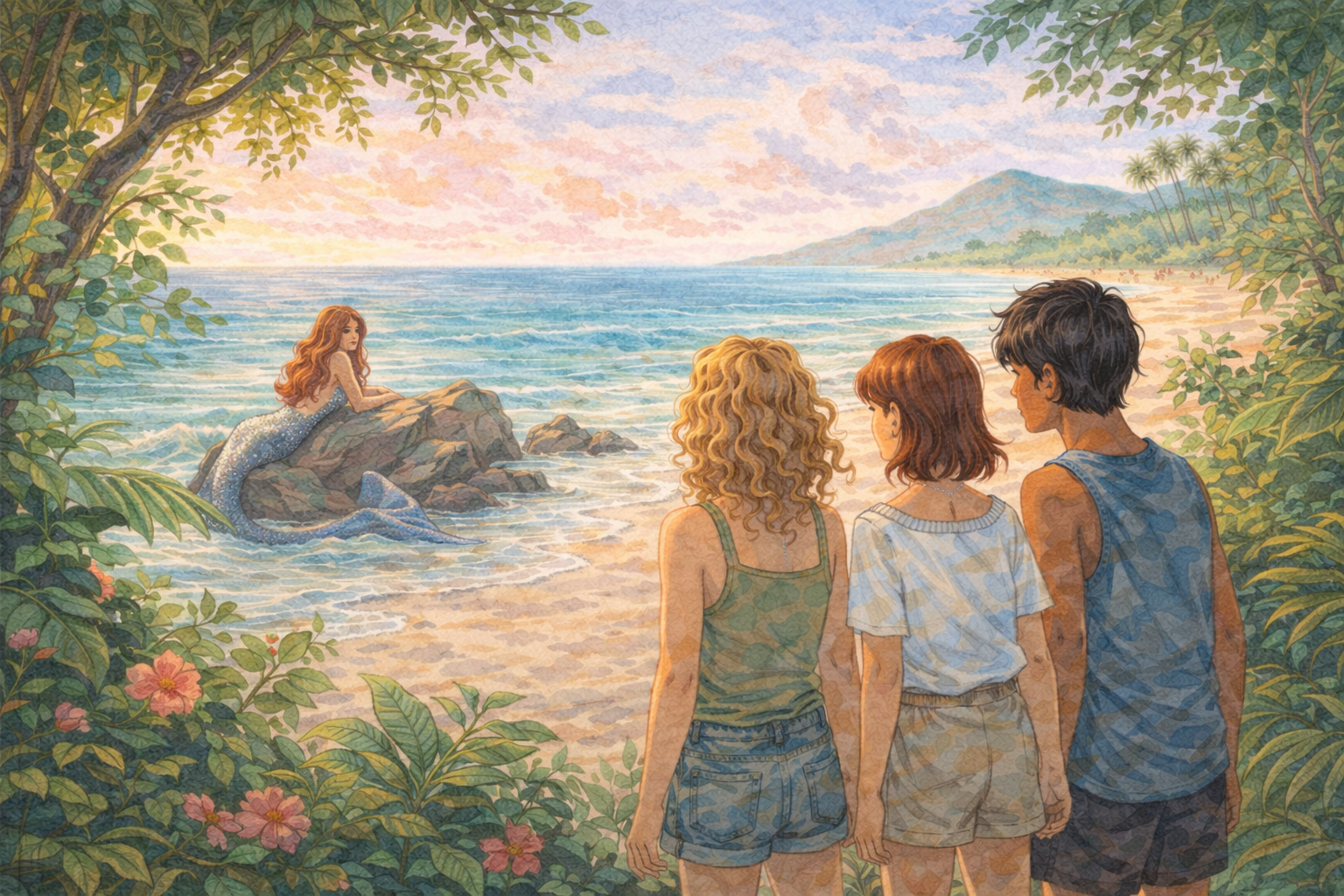
“I don’t even know if it’s real or not,” she confessed.
“Tell me,” he pressed.
“I’ll show you.”
She called for Sal, and he came running from the library as she held her pearl necklace with her left hand and grabbed Fabián’s hand with her right, guiding him through the path in the garden without knowing what she would find this time, whether it had been a dream or a vision like the one earlier last night; she closed her eyes when she felt closer to where the wall should have been, but kept walking, and walking, as the path stretched longer again.
She looked back at Fabián, whose eyes were fixed on the trees, confused and shocked, his mouth slightly open and his hand growing sweaty, and only then did she realize she was still holding it, letting go abruptly.
Everything was still there, the trees and the sand, but something had changed in the daylight, as if the island had withdrawn into itself, quieter now, almost emptied of something she couldn’t quite name, the magic that had been so present last night before just out of reach; it was her old island again, simpler, the one she had known with her friends and family for years, still special but less magical, and the glowing pool was gone.
“Is it a… quail passage…” Fabian asked, his voice almost lost in the trees.
“A what?”
“It’s a passage that connects two natural grounds through a common stone.” His focus back again.
“I don’t know,” she said as she walked toward the beach, where she spotted the large boats sailing away.
“Come,” she added, quieter now but firm. She wanted to make sure the island was empty now.
They followed the curve of the island toward the place where she had seen the horse, moving through something that felt both familiar and not, until they reached the rocks and found what had been left behind, machinery, heavy and out of place, cutting into the natural shape of the land.
Fabián slowed beside her.
“Are you seeing that?” he said, pointing toward the water beyond the rocks.
She noticed it before she could name it, because something in the water felt wrong in a way her body understood before her mind did; just beyond the break, where the waves should have folded in their usual rhythm, the surface tightened into a slow, circling pull, as though something beneath it were drawing the sea inward, foam gathering where it shouldn’t and the light bending strangely across the water.
Marisol narrowed her eyes, following the movement, the shapes cutting through the blue, rising and disappearing again in a tense pattern.
“Sharks?” he asked.
She stepped closer, the wind pushing her hair across her face, and when one of the bodies surfaced again, smooth and curved, the motion fluid instead of sharp, recognition settled in her chest.
“No,” she said. “Dolphins.”
There were more than she first thought, their bodies weaving through the water in restless loops, not hunting or scattering but gathering around a single point, as if something unseen held them there.
On the rocks nearby, smaller creatures had climbed out of the water, crabs gripping higher than usual, a pale bird with wet wings held awkwardly at its sides, even small fish flickering in the shallows, and none of them moved the way they should, none feeding or fleeing, only still, all turned toward the same place.
Watching.
“That’s not natural,” she said, already pulling her shirt over her head.
“Hey, wait,” Fabián said, stepping closer, his voice tightening slightly, “what if you get pulled in?”
She shook her head, kicking off her shoes, her attention fixed on the water.
“I won’t dive. I’ll just look.”
The sea met her colder than she expected, the temperature shifting sharply against her skin, and by the time it reached her waist she could feel it clearly, the pull threading through the water, subtle at first and then unmistakable, like a current that did not belong to the tide.
She drew in a breath and slipped under.
Sound fell away into a low hum that seemed to vibrate through the water itself, and the light fractured above her as she pushed deeper toward the pull.
The water moved wrong.
Sand lifted from the seabed in slow spirals, drifting upward as if drawn by something unseen, and ahead of her a dark structure loomed, half buried and corroded, its shape unclear, its purpose unreadable, its open mouth pulling water inward with a steady mechanical force.
Something left behind.
The dolphins circled just beyond it, their movements broken, dipping toward the pull and veering away again.
And there, caught in the pull, she saw it.
A smaller dolphin.
Too close.
The current dragged at it in uneven surges, pulling it sideways each time it tried to swim away, its strength fading as it was drawn back toward the machine.
Marisol’s chest tightened.
She turned and pushed back to the surface, breaking through with a breath that came too fast.
Fabián was closer now, the water around his ankles, his expression tight.
“What is it? What’s happening?”
“There’s a dolphin,” she said, her breath uneven. “It’s being pulled in. There’s something down there, some machine, I don’t know what it is.”
“Pulled in?”
“If it can’t get up, it’ll drown. They breathe air.”
Her hand moved to her necklace, and for a moment she hesitated before pulling it off.
She dropped to her knees in the wet sand, digging quickly and pressing it beneath the surface, covering it just enough before placing her palm over it.
“Are you enchanting it?” Fabián asked.
For a moment nothing changed.
Then a faint blue light seeped through the sand between her fingers.
“Marisol… why didn’t you tell me?”
Water dripped from her hair into her eyes, but she didn’t move her hands, only shook her head slightly.
“This isn’t for the assignment,” she said. “It’s for the island.”
The light flickered once, then faded.
She pulled the necklace free, brushed the sand from it, fastened it back around her neck, and dove again.
The cold closed over her as she pushed deeper into the pull, the pressure tightening around her ribs while the smaller dolphin drifted closer, its movements slowing.
She reached it, unsure at first how to hold it as its body twisted, the current fighting her grip and pulling both of them sideways, but she wrapped her arms around it and tried to swim away.
Her lungs began to burn.
Almost there.
She adjusted her angle, letting the current guide her just enough instead of fighting it.
The dolphin slipped free.
For a second everything stilled.
Then it surged upward.
Marisol followed, but the burn in her lungs turned urgent, her body growing heavy.
She broke the surface with a sharp gasp.
“Marisol!”
Fabián was in the water now.
Too far in.
“Don’t,” she tried, but the word broke as he reached her, grabbing her arm, and the current shifted under him, pulling at his footing.
For a moment the water closed over both of them.
Then something moved through it.
Steady.
The horse stepped into the sea, the current breaking around its legs as it moved forward without hesitation; Fabián grabbed onto it, pulling her with him, and she felt herself lifted as they were carried back toward the shore, the force loosening with each step.
By the time her feet touched sand again, the pull felt distant.
The horse lowered enough for them to slide off.
Marisol lay on the shore, coughing, her chest filling with air as she heard Fabián nearby doing the same, while beyond the break the dolphins had scattered and the water moved as it should.
They lay there for what felt like a long time, Sal pacing in quick circles, meowing until he calmed as her breathing steadied.
When she was able to stand, she walked toward the horse, noticing how different it looked now, its mane dry and messy, its coat a soft cream color, no longer glowing the way it had at night, almost like a wild horse except for the braided beads that reassured her it was the same.
Fabián came over. “Who is this handsome gentleman?”
“I don’t know his name,” Marisol said. “I met him last night.”
Fabián touched its mane on one side while she did the same on the other.
“Do you want to talk about it?” he asked gently.
“I thought you would yell at me,” she said.
“I thought so too,” he admitted. “But I understand.”
They looked at each other.
“We almost died saving a baby dolphin,” he said.
“We almost died saving a baby dolphin,” she repeated, the tears coming with a small, nervous laugh.
“And a horse rescued us,” she added.
“Anemos,” Sal’s voice echoed in her mind.
She said it out loud. “Anemos.”
The horse looked at her immediately.
“Is that your name?” she asked softly. “Thank you.”
They walked back toward the garden, Fabián watching her necklace as it glowed faintly.
“So…”
“So…”
“Why do you think this path opened? What’s special about this place?” he asked as they stepped out of the garden and sat by the columns with the beach towels.
“We didn’t even have time to talk about it,” she said. “It’s different during the day. It’s just an island, a real island. People go fishing there, kayaking, surfing. I used to go there with my friends all the time, with my grandparents, by boat of course. But last night I came through the path and it looked different. It felt different. Anemos looked completely different, like a dream. There was also a pond with creatures I have never seen before.”
“I saw what Anemos looks like,” Fabián said. “I saw it underwater. You must’ve been too tired to notice, but he changed. He was… something else. His fur looked like it was glowing, like electricity.”
“Yes,” she said. “That’s exactly what he looked like last night.”
“Outside the water?”
“Yes.”
They both paused, trying to make sense of it.
Her dad walked in with bags.
“Hey guys, your mom will be here in an hour, so I’m starting dinner. You have that time to finish studying.”
Marisol and Fabián looked at each other and went into the library following Sal.
“I haven’t come in here in years,” she said.
“Why?” he asked.
“I don’t know. It reminds me too much of my grandparents. I felt more like them than my parents. I’m afraid they don’t really understand me or care about what I want.”
“What do you want?” he asked.
“I want to stay here,” she said, meeting his eyes. “This is my home.”
“This place is beautiful,” he said quietly, “but you have bigger things ahead.”
She stood up. “You’re exactly like them.”
“Wait,” he said quickly. “That’s not what I meant.”
She hesitated.
“I mean you have a gift. You’re part of something bigger, and it’s not going to let you ignore it. You need to learn how to handle it.”
“I thought you said you wanted to help me.”
“I do. With this… and with school.”
She sighed, and after a moment, she gave in.
He moved through her grandfather’s library with ease, pulling books from the shelves, dust lifting into the air, while Salado watched from her grandmother’s art trunk.
“There’s a place I want to show you,” he said. “I haven’t seen it myself, but my great aunt told me about it. We have to go at night.”
“My parents won’t let me go out at night.”
“I’ll come get you,” he said casually.
She raised her eyebrows, a small smile forming. “I didn’t take you for the rebellious type.”
“I guess I’m not the little prince you thought I was,” he said, smiling slightly.
