
Chapter 2: The Letter
After assuring Charlotte she was fine, they embraced and said goodnight. Marisol watched her as she skated away.
She crossed the street and walked home. The house stood just steps from the beach, an old colonial home, modest in structure but full of a quiet, undeniable charm. It wasn’t special because a family of witches lived in it; it was special because it had the warmth of her loved ones, of her neighboors and of the fire lanterns that shune though the darkness of the night.
It had belonged to her grandparents—her father’s parents. Her grandfather had been a wizard, and her grandmother, the daughter of a fisherman, had spent her youth helping sell the day’s catch before becoming a pearl diver. Their lives still lingered there, not in anything obvious or magical, but in the way the house held warmth even when it was empty, in the way the wood creaked like it remembered voices, in the way the air itself seemed to carry stories that refused to disappear.
Her grandfather Ognjen had come from Croatia to study curses in the new continent. He had become intrigued by Lope de Aguirre, a terrible and vicious character but also quite mysterious. He followed a trail of Aguirres curses throught the continent until he reached El Tirano. People who knew the tales said Aguirre was mad. Her granfather believed Aguirre had found a key to magic, deep magic, which he used to reach his human desires, and that create a whole new web of issues. He was only supposed to come to El Tirano for a month but there he met Maria Helena and so one month turned into a summer, and summers are eternal in Margarita, so he sayed and dedicated his life to lifting the curse over this town as oppose to just studying it, but he never did reach that goal. He did reach a much greater one, married Maria Helena, bought the old house across the beach in El Tirano and together they built a life there, a quiet but beautiful life.
Marisol’s parents had never quite belonged to it. They were both powerful witches, trained in the finest schools in Europe, fluent in spells, potions, and ancient rules—everything the magical world considered important, everything that required discipline and precision and control. Margarita, with its salt and heat and looseness, had never fully claimed them, and in quiet moments Marisol would tease them for it, calling them navegaos—castaways, people who weren’t born on the island, even though they were. They never found it funny, and beneath the small jokes there was always something sharper waiting.
They wanted her to study abroad.
It came up often, sometimes gently, sometimes not, but always with the same weight behind it, the same certainty that her life was meant to happen somewhere else, somewhere bigger, somewhere better. Her parents were structure, discipline, books stacked neatly on polished tables, a future that could be mapped and measured. Marisol was sun and salt and sea, something less defined and far more rooted at the same time, and she could not imagine herself anywhere else.
After she changed, dinner was ready. The house opened inward, built around a square garden at its center, with open hallways framing it on all sides so that no matter where you stood, your eyes always returned to that green, living heart. Outside her room, along the corridor, a hammock hung between two columns, its woven threads slightly worn from years of use; it was her refuge, especially on nights when dinner turned into difficult conversations she didn’t want to have. Tonight, she had already made “reservations” to scape to the hammock after dinner.
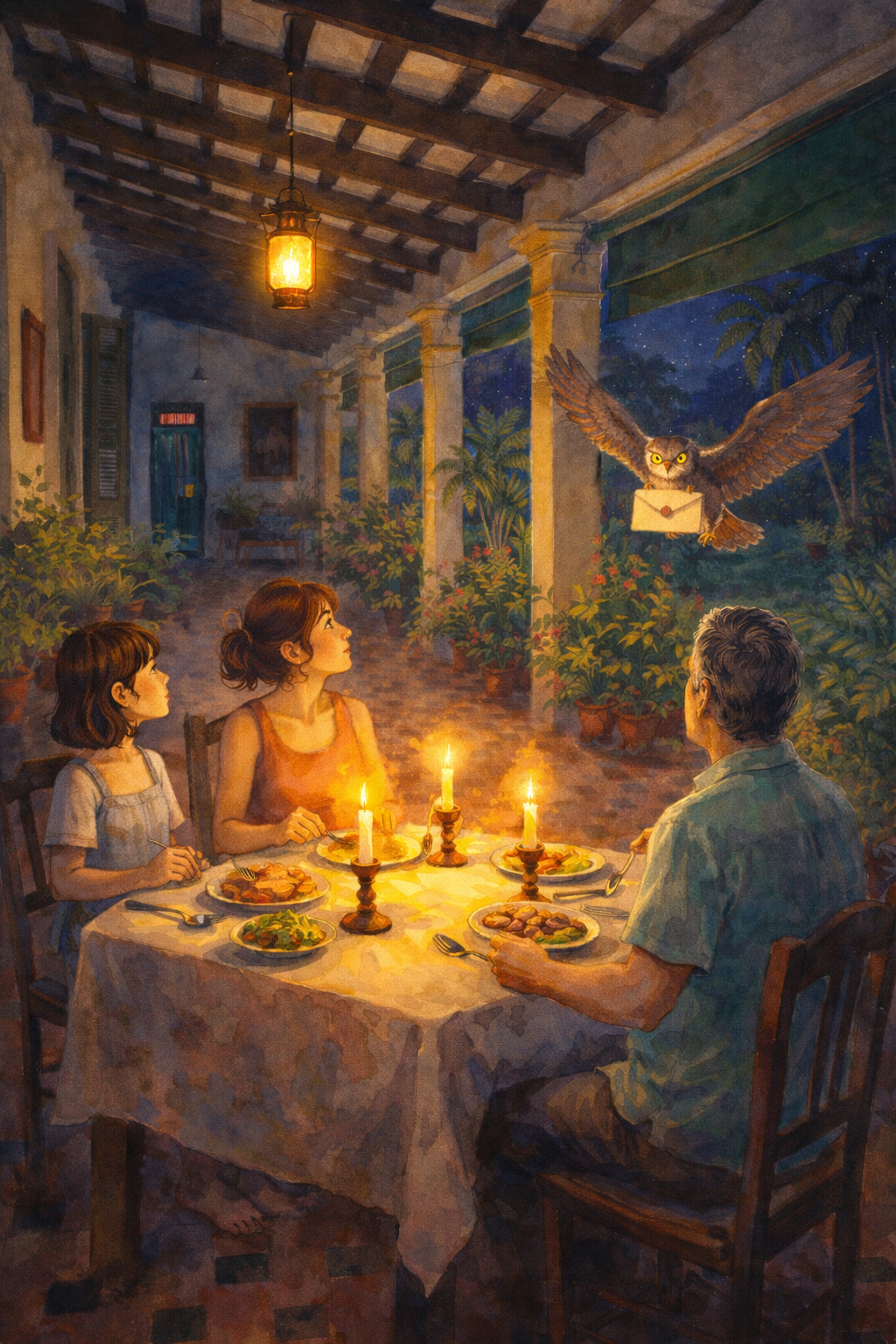
They sat at the table together, the sound of the ocean drifting in from across the street and settling quietly between them. Her mom had made jerk chicken with sweet fried plantains, smothered in butter and Queso llanero, her absolute favorite, and the familiar smell filled the house with something warm and comforting.
Her dad, however, wasn’t eating. He was looking out toward the garden, his gaze fixed somewhere beyond the archway as the breeze began to pick up, gently at first and incresently more agressibly.
“What’s happening?” Marisol asked, after swallowing her first bite.
“Long-distance mail,” he said with a small smirk, pulling the napkin from his lap as he stood and walked toward the garden steps. He rested one hand against the arch and looked up at the night sky.
Marisol and her mom followed his gaze, but they couldn’t see anything.
Then, for a brief moment, the moonlight disappeared. A sudden hush swept through the air, sharp enough to make Marisol drop her fork.
Another hush followed— and then a massive black-feathered bird descended from the sky.
Her father walked to the opnening of the garden, were the bird landed. He bowed slightly before coming closer to it and it bowed back at him, extending a claw from wich it held a small package, covered in stamps and tight on a red string. The bird didn’t stay long; it lifted back into the night in another hush of wind almost immediately, disappearing as quickly as it had come.
“Marisol, close your mouth,” her father said with a quiet laugh as he walked back to his chair.
“Was that a dragon?” she asked, still staring, though not so shocked that she stopped eating her plantains.
“What?!” His voice jumped higher than she had ever heard it.
“That was a Andean Condor,” her mother said calmly. “They’re not even magical creatures. They’re just birds enchanted to become slightly larger.”
“I’ve never heard of a natural flying bird that size” She sounded doubtful.
Her father looked at Marisol, disbelief turning quickly into irritation.
“I can’t believe you don’t know the difference between a bird and a dragon. You’re a 13 year old witch Marisol. Are you studying at all between surfing and fishing with your friends?” His tone shifted, sharper now.
Her mother held his shoulder tightly, as if to signal him to calm himself, before she left to the kitchen. Marisol’s dad seemed to be strict and unmovable, and even though her mom didn't say much, the few times she did speak, he always agreeed with her.
He sighted, relaxed his shoulders and continued with a softer tone,
Because this package,” he added, holding it up slightly, “came with a letter for you—from the school you’re supposed to attend this year.
He got the letter from inside the larger package, broke the purple seal and began to read.
Marisol stayed quiet for a moment after her father finished, her hands resting on the edge of the table, her fingers pressing lightly against the wood as if grounding herself while she tried to gather the courage to speak.
She had never been good at this, at confrontation. People often mistook her for someone bold, maybe even rebellious, the way she dressed, sun-touched and salt-worn, her hair always a little wild from the ocean, her style somewhere between surfer and something a little rougher around the edges, but that wasn’t who she truly was. Not yet at least.
She was soft, calm, the kind of person who would rather let things pass than turn them into conflict, and even now her first instinct was to nod, to accept, to let the moment move on without resistance.
But something in her didn’t let her. Not this time.
He father read the letter in silence. She didn't know if he would explain it to her, read it out loud or if he simply didn't see the point in letting her have an opinion about it.
She swallowed, her throat tightening before she even spoke, and when she finally did, her voice came out quieter than she intended.
“I don’t want to go.”
It trembled slightly, and she felt it immediately—that familiar break, like her words were too fragile to carry the weight of what she meant.
Her parents exchanged a glance as her mother came back to gather more dishes and for a second she almost pulled back, almost softened it, almost said it didn’t matter—but instead she held on, lifting her eyes again.
“I know you think it’s what’s best,” she said, her voice unsteady but honest, “but I don’t feel like I belong there… I feel like I belong here.”
The words came slowly, as if each one had to find its way out.
“This is serious, Marisol. It’s about your future,” her father said.
“I think my future is here.”
“Your future is bigger than this island.”
He looked back at the letter and read part of it again, this time out loud.
“You have 2 months to successfully enchant an object. This is your test.”
There was tension in his voice now, something tight beneath the words. He put the letter down, leaned back in his chair and gave her a sharp, silent look, then he looked at the letter again and added, more measured:
“And pass an academic English test.”
“That part will be fine,” her mother said from the kitchen.
Her father didn’t respond right away.
“If you don’t pass this…” he said finally, hesitating just for a moment,"you’ll go to Gavidia. You’ll live with your grandmother Salomé until you’re ready.”
“But I don’t see the…”
Her mother’s call from the kitchen interrupted her “Honey, come help me do the dishes”
Marisol wasn’t able to finish. Her father stood up and walked away from the table, already gathering the dishes as if the conversation had ended on its own.
The words stayed unfinished between them.
She remained there for a second, staring at the empty space he had left behind, before slowly pushing her chair back. She walked away dragging her feet, a quiet heaviness settling in her chest, her thoughts louder than anything they could have said.
She escaped to the hammock, wrapping herself tightly in its woven fabric until it held her like a cocoon, like something that could keep the world out for a while. She stayed there even after their voices faded into the background, the anger still sharp under her skin, tangled with something harder to name, fear maybe, or the quiet realization that this time, they meant it. She had 2 months to complete a task her heart refused to claim.
But it wasn’t just the thought of leaving the beach, the sun, the rhythm of the waves, or the laughter of her friends that unsettled her. It was something quieter, deeper, harder to name. A fear that once she left, life might carry her somewhere else entirely, pulling her into expectations that weren’t hers, into paths she hadn’t chosen, into a version of herself shaped far from the island.
She had seen it happen before. People left, promising to return, and somehow never did. The island became a memory. She couldn’t bear the thought of that happening to her. So she held on to a hope she didn’t dare speak too loudly—that her parents might change their minds, that they might see what she felt, and allow her to stay… to grow where her roots had already deepen.
Her cat Salado appeared not long after, leaping softly onto the hammock and settling on top of her chest. His black fur, warmed and slightly bleached by the sun, carried the faint smell of salt and sand, and when she reached up to touch him, he answered with a low, steady purr that vibrated gently through both of them.
“Hi, Sal…” she murmured, her voice barely above a breath.
She closed her eyes for a moment, letting the sound ground her. “What am I supposed to do?”
Sal blinked slowly, as if he already knew something she didn’t.
Through the small openings in the hammock’s weave, she watched the garden, the leaves moving gently in the evening breeze, swaying to the soft rhythm of bossa nova drifting from her grandfather’s old radio, the one she always turned on during dinner, because it made the house feel full again, as if her grandparents were still there, sitting at the table, laughing, defending her, telling stories about the sea.
She glanced at the hall that met with the main door and remembered how her grandpa would always walk in, pretend he sneezed and splash her with water from the little fountain at the entrance. She let out a laugh.
Leaving this place wouldn’t just mean leaving home.
It would mean leaving them too.
And even as that thought settled, quiet and heavy, something deeper in her refused to accept it, like a part of her already knew that whatever was coming, whatever had begun out there on the water, was not going to let her go so easily.
